

In the rapidly expanding realm of online education, Udemy has long been a go-to destination for learners seeking a diverse array of courses. However, for those eager to broaden their horizons or find platforms catering to specific needs, numerous alternatives exist. Let’s delve into five prominent Udemy Alternatives, comparing their features, strengths, and areas of focus.
The eLearning sector is anticipated to reach a value of $1 trillion by 2028. One of the leading contenders in this domain is Udemy, boasting a user base of over 50 million learners and an extensive collection exceeding 200,000 courses.
Despite Udemy’s popularity in the online learning sphere, it’s essential to recognize the alternative abound in the market. These udemy alternatives offer creators and learners increased autonomy, enhanced creative opportunities, and more cost-effective solutions, ensuring a greater share of earnings for participants.
Quick info on Udemy
Launched in 2010 by Eren Bali, Gagan Biyani, and Oktay Caglar, Udemy has emerged as a leading platform, boasting over 52 million students and 68,000 instructors offering courses on diverse topics, ranging from synthesizers to Adobe Photoshop. During the early stages of the pandemic, Udemy experienced a staggering 425% surge in paid enrollments as more individuals turned to online learning.
Udemy provides numerous benefits to creators and educators, with its user-friendly interface enabling the production and promotion of online courses without requiring technical or design expertise. While the platform offers access to a vast audience for marketing purposes, there are drawbacks to consider.
Pros of Udemy
- Ease of initiation: Signing up for Udemy is straightforward, and the platform offers resources to assist with course planning, recording, and publication.
- Extensive course selection: With over 200,000 courses available across various subjects, Udemy boasts a comprehensive course library.
- Global instructor community: Joining a community of instructors from around the world provides valuable tips and guidance for aspiring course creators.
Cons of Udemy
- Competitive marketplace: The abundance of courses on Udemy makes it challenging for content to gain visibility and stand out.
- Lack of data ownership: Instructors have limited control over customer data, which can hinder business growth, platform switching, and control retention.
- Stringent requirements: Udemy enforces quality control on all courses, necessitating adherence to an extensive list of requirements for content approval.
- High fees: Udemy retains 63% of revenue generated from courses sold through its marketplace, posing a significant cost to creators & students.
While Udemy remains a prominent online learning platform, it’s important to explore udemy alternatives. Are you curious about the best Udemy alternatives in 2024? Let’s delve into the top solutions you should know about.
Top 5 best Udemy alternatives
Below, we present our selection of the top udemy alternatives in 2024, highlighting key features, advantages, drawbacks, and additional considerations.
Kodacy is one of the best among the list of udemy alternatives in 2024. Kodacy emerges as a dynamic force in the realm of online learning, offering a fresh approach to education that prioritizes collaboration, creativity, and community engagement. With its unique features and user-centric design, Kodacy stands out as a platform poised to revolutionize the way we teach and learn.

Advantages of Kodacy:
- Community-Centric Platform: At the heart of Kodacy lies a vibrant community of learners and instructors. The platform fosters interaction, collaboration, and knowledge sharing among users, creating a supportive environment conducive to learning and growth.
- Flexible Course Creation Tools: Kodacy empowers instructors with intuitive tools and resources to create engaging and immersive learning experiences. From video lectures to interactive assignments, instructors have the freedom to design courses that cater to diverse learning styles and preferences.
- Emphasis on Quality: Quality is a cornerstone of Kodacy’s philosophy. Courses undergo rigorous review processes to ensure they meet high standards of content relevance, instructional design, and production quality. This commitment to excellence enhances the overall learning experience for users.
- Fair Revenue Sharing Model: Kodacy operates on a transparent revenue sharing model that benefits both instructors and the platform. Instructors retain a significant portion of the earnings generated from their courses, fostering a sense of partnership and incentivizing quality content creation.
- Diverse Course Offerings: Kodacy boasts a diverse range of courses spanning various subjects and disciplines. From technical skills to personal development, users can explore a wealth of topics tailored to their interests and career aspirations.
- Interactive Learning Experience: Kodacy enhances engagement through interactive features such as discussion forums, quizzes, and collaborative projects. This interactive approach keeps learners actively involved in the learning process, leading to deeper understanding and retention of concepts.
- Accessibility and Affordability: Kodacy prioritizes accessibility by offering affordable pricing plans and flexible payment options. This ensures that quality education is accessible to learners from all walks of life, regardless of geographical location or financial constraints
Kodacy stands out as a premier option for anyone considering Udemy alternatives due to its emphasis on accessibility, affordability, and quality.
Coursera is another top contender among Udemy alternatives, Coursera stands out as a leading platform for online education, offering courses, specializations, and even full degree programs in partnership with top universities and institutions worldwide. With a focus on academic rigor and quality, Coursera provides learners with access to courses across a broad spectrum of disciplines, including business, computer science, humanities, and more. The platform also offers certificates and degrees recognized by employers, making it an attractive option for those seeking to enhance their credentials.
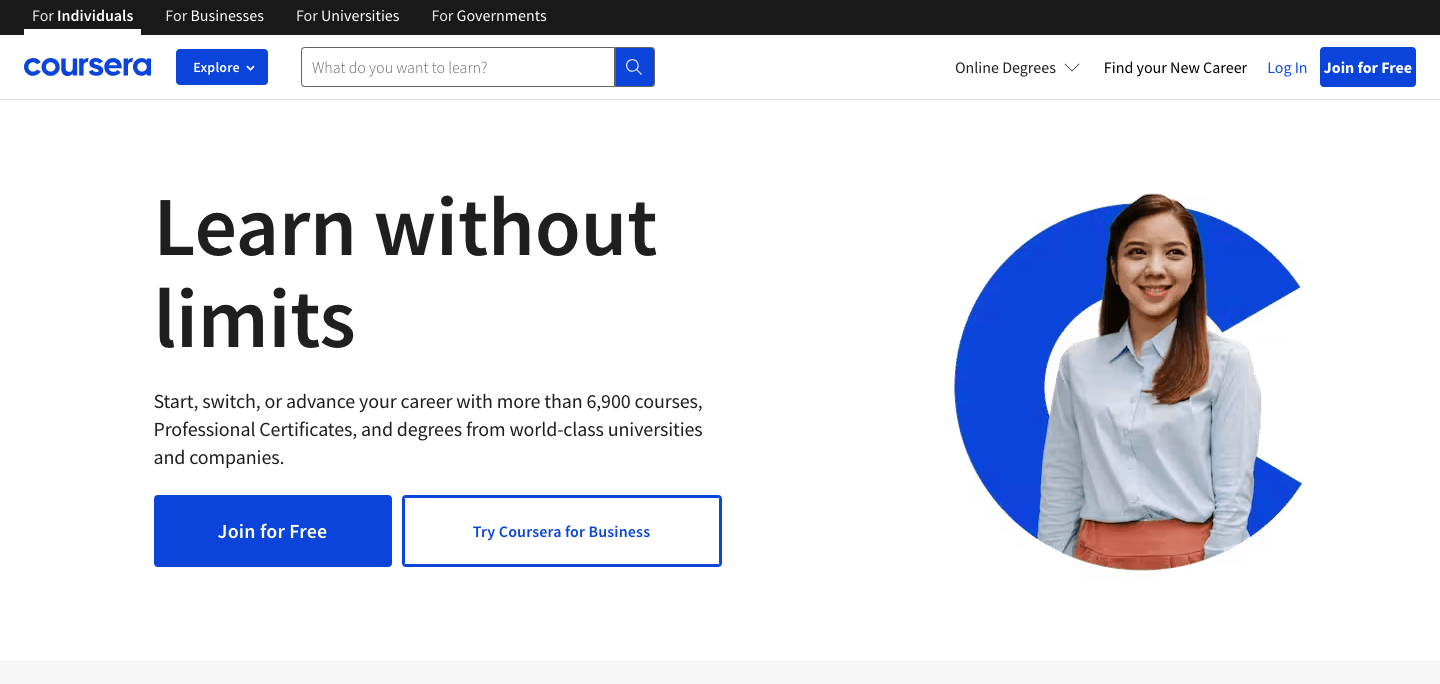
With an extensive catalog boasting more than 5,300 courses, along with a variety of professional courses, specializations, and Mastertrack courses, Coursera emerges as a prestigious alternative to Udemy, catering primarily to business professionals and academics. What sets Coursera apart is its emphasis on certifications from accredited institutions, recognizable even by the most traditional academic standards. These certifications hold value beyond the platform, allowing students to transfer credits to colleges and universities, thereby opening doors to academic advancement from the comfort of their homes. Additionally, learners from non-traditional academic backgrounds can leverage Coursera certifications to access new opportunities.
In contrast to Udemy’s flexible course durations, Coursera courses typically span four to twelve weeks, featuring one to two video lectures per week. Instructors actively engage with students by grading assignments, addressing queries, and ensuring an immersive learning experience. Coursera boasts partnerships with over 275 universities and institutions worldwide, including prestigious names like the University of London, Yale University, the University of California, Irvine, the University of Michigan, as well as Meta and Google.
However, Coursera’s collaboration with large institutions can slow down the application process. While quicker than applying for a traditional university degree, some learners may prefer platforms where enrollment and course commencement take mere minutes rather than days.
Pros:
- Abundance of free courses: Coursera offers over 1,500 free courses, enabling learners to enhance their skills without financial strain.
- Accredited courses: Unlike Udemy, Coursera specializes in courses backed by renowned institutions, enhancing credibility and recognition.
- Strong institutional partnerships: Universities and corporations can showcase expertise and generate revenue by offering courses through Coursera.
Cons:
- Limited accessibility for individual creators: Coursera primarily partners with institutions and industry experts, making it less feasible for independent creators to join.
- Resource-intensive: Creating a full-length course on Coursera demands significant time and financial investment, as educators must actively engage with students and manage course-related tasks.
- Difficulty in standing out: Competition on Coursera can be fierce, making it challenging for new courses to gain visibility amidst established offerings.
3. Datacamp :
Expert-level coders and data whizzes, listen up – this is the Udemy alternatives for you! Founded in 2013, DataCamp offers 400+ data courses taught by subject matter experts, geared towards learners interested in careers in data science and analytics.

DataCamp stands out as a premier online learning platform for aspiring data scientists, boasting highly interactive courses tailored to its audience of over 9 million learners. For aspiring data scientists, DataCamp is an ideal choice among Udemy alternatives.
Educators recruited by DataCamp are not only passionate about teaching but also possess expertise in analytics. To publish a course on DataCamp, prospective instructors must undergo a rigorous application process, which may take some time to complete.
The application process begins with selecting a course from DataCamp’s wishlist and submitting a potential course outline through a Google form. Successful applicants proceed to a brief five-minute presentation, elucidating a key concept from their proposed course outline. Upon approval, instructors receive support from DataCamp’s in-house experts to develop their course content.
Instructors on DataCamp are compensated through a revenue-sharing program based on course completions. As DataCamp subscribers progress through a course, instructors receive royalties, providing a source of passive income. Top instructors report substantial earnings, with some generating over $53,000 annually.
While data science remains a niche field, its popularity is burgeoning. For individuals with expertise in analytics seeking to share their knowledge, DataCamp presents an ideal platform.
Pros:
- Vast and engaged community: With over 16.9 million registered learners, DataCamp boasts one of the largest user bases in the data science realm, offering instructors access to an extensive and active community.
- Royalty-based compensation: Unlike Udemy, DataCamp instructors are remunerated based on course completions, incentivizing the creation of engaging and valuable content. Top performers have the potential to earn six-figure incomes.
- Content ownership: Creators maintain full ownership of the content they produce and publish on the DataCamp platform.
Cons:
- Limited subject scope: DataCamp exclusively caters to data and computer scientists, limiting opportunities for individuals in other fields. Those seeking broader subject coverage may prefer more general online learning platforms like Thinkific.
- Stringent acceptance criteria: Even seasoned data scientists may face challenges gaining acceptance as DataCamp instructors without substantial industry credentials and teaching experience.
- Quarterly payments: Royalties from DataCamp’s revenue-sharing program are disbursed quarterly, resulting in periodic cash flows rather than a steady income stream.
Skillshare distinguishes itself among Udemy alternatives as a platform focused on creativity and practical skills, offering a wide range of classes in areas such as design, photography, writing, and entrepreneurship. With a strong emphasis on project-based learning and community interaction, Skillshare encourages learners to explore their interests and collaborate with others through workshops and discussions. The platform’s subscription model provides unlimited access to thousands of classes, making it an affordable option for lifelong learners.

Skillshare stands out as one of the premier alternatives to Udemy, recognized as one of the largest online learning platforms since its inception in 2010. With a membership exceeding 12 million users, Skillshare offers a vast marketplace for learning and teaching.
Similar to Udemy, individuals join Skillshare as course creators, crafting and publishing their course content online. However, what sets Skillshare apart is its unique approach to course marketing. The platform assumes responsibility for promoting content and facilitates connections between learners and industry experts, significantly reducing the workload associated with marketing for instructors.
Another notable distinction between Skillshare and Udemy lies in their pricing models. While Udemy operates on an à la carte basis, with students purchasing individual courses, Skillshare adopts a subscription-based approach. Under this model, students pay a flat fee for access to the entire course catalog on the platform.
For instructors, this translates to compensation from Skillshare’s royalty pool, rather than individual course sales. Thirty percent of all monthly Premium Membership fees contribute to this pool, with creators receiving a portion based on the “watch time” their content accumulates each month.
Additionally, Skillshare offers opportunities for instructors to earn income through student referrals. Instructors receive a $10 bonus for each new student who signs up using their referral link, allowing them to monetize existing audiences beyond the Skillshare platform.
Pros:
- Extensive potential audience: With millions of users already engaged on Skillshare, instructors have access to a broad audience for their content.
- High-quality course content: Skillshare incentivizes creators to produce top-notch courses by compensating them based on viewership duration, encouraging the creation of engaging and valuable content.
- Art-focused learners: Unlike some e-learning platforms that primarily cater to business and technology subjects, Skillshare attracts learners passionate about art and craft-related skills, offering a niche market for instructors in those areas.
Cons:
- Limited earning potential: Since compensation is tied to viewership time rather than course sales, creators’ earnings depend on how much their content is watched, potentially limiting income potential.
- Uncertain income: Instructors may not meet revenue goals if their courses do not garner sufficient viewership, resulting in fluctuations in monthly income.
- Monthly royalty payments: Unlike some platforms that offer more frequent payouts, Skillshare distributes royalty payments on a monthly basis, requiring instructors to wait for earnings to appear in their bank accounts.
Khan Academy is one of the alternatives that provides free, high-quality educational resources covering subjects from math and science to humanities and test preparation. Founded with the mission of providing a free, world-class education for anyone, anywhere, Khan Academy offers instructional videos, practice exercises, and personalized learning dashboards to help learners of all ages and backgrounds succeed. Whether you’re a student looking for extra support or an adult seeking to brush up on foundational concepts, Khan Academy offers a wealth of educational content at no cost.

Khan Academy, founded by Sal Khan, embodies the mission of democratizing education by providing accessible learning resources to students from diverse backgrounds. While renowned for its expertise in mathematics and the sciences, Khan Academy offers instruction across a broad spectrum, spanning from computer science to economics.
In addition to serving students, Khan Academy provides valuable tools for educators and parents supporting their children’s educational journey. The platform facilitates lesson assignments, progress tracking, and content customization through a user-friendly learning dashboard.
For individuals seeking free and dependable learning materials tailored to students of all ages, from elementary school to college, Khan Academy emerges as a top alternative to Udemy.
All content on Khan Academy is developed in-house and is generously funded by sponsors such as Bank of America, CollegeBoard, and the Bill and Melinda Gates Foundation. While this model ensures high-quality content, it also means that Khan Academy is not open to independent course creators seeking to monetize their digital products. Nonetheless, it remains a preferred choice for students, parents, and educators alike.
Pros:
- Free access: Khan Academy offers its courses free of charge to all students and teachers, making it an invaluable resource for public school educators seeking high-quality learning materials at no cost.
- Student-centric approach: Khan Academy’s content is meticulously tailored to cater to students’ needs, with specialized material organized by subject and grade level.
- Customized learning paths: While users cannot create entirely bespoke learning tracks or upload their own courses, they have the flexibility to select specific lectures for students and group related concepts together.
Cons:
- Limited access for course creators: Khan Academy exclusively manages its content internally, precluding opportunities for individual course creators and organizations to contribute.
- Absence of revenue generation: Given its philanthropic model, Khan Academy does not offer avenues for earning income through the platform, making it unsuitable for businesses seeking monetization options.
- Narrow scope of topics: Khan Academy primarily caters to the American education system, resulting in limited content diversity in areas such as technology, arts, and language learning compared to other platforms.
For those seeking inspiration from renowned experts and industry leaders, MasterClass offers a unique learning experience with courses taught by celebrities and accomplished professionals. From cooking with Gordon Ramsay to filmmaking with Martin Scorsese, MasterClass provides intimate access to insights and techniques from masters in their respective fields. While the platform’s focus is more on inspiration and storytelling than traditional education, it offers a valuable opportunity for learners to glean wisdom from the best in the business.

Featuring over 200 classes spanning 11 categories, including Science & Technology, Arts & Entertainment, and Design & Style, Masterclass offers a diverse array of learning opportunities. Each class comprises an average of 20 lessons, each lasting 10 minutes. The platform operates on a subscription model, with pricing starting at $10 per month, billed annually.
Pros:
- Engaging and enjoyable: Masterclass stands out for its entertaining courses, often led by celebrity instructors who impart knowledge on topics of passion to learners.
- High production quality: The videos on Masterclass exhibit exceptional production values, captivating viewers with their cinematic allure from the outset.
- Renowned instructors: One of Masterclass’s key attractions is the opportunity to learn from globally recognized experts in various fields. Examples include Gordon Ramsay teaching cooking, bestselling author Dan Brown instructing writing, and Spike Lee sharing insights into filmmaking.
- Cost-effective: Masterclass offers affordability compared to other educational platforms, though its course selection is more limited than competitors like Udemy or Skillshare.
- Generous refund policy: Subscribers enjoy a 30-day window to request a refund after purchasing a Masterclass membership, offering peace of mind to users.
Cons:
- Lack of free courses: Unlike some udemy alternatives, Masterclass does not offer any free courses, requiring users to subscribe before accessing content.
- Limited community interaction: While the instructors are the focal point of each class, there is minimal engagement between instructors and the community. Improved instructor-community interaction could enhance the learning experience.
- Limited educational depth: Despite structured courses, Masterclass may lack substantial educational value, resembling more of a high-quality TED Talk on steroids rather than in-depth educational content.
- Narrow subject range: Masterclass offers a relatively limited range of topics, primarily focusing on sports, filmmaking, cuisine, writing, business, science, and politics.
Whether you seek academic credentials, professional development, or creative inspiration, these udemy alternatives offer valuable resources and experiences to enrich your educational journey.
FAQs About Udemy Alternatives
While Udemy is a leading online learning platform, alternatives may better cater to specific needs such as specialized courses, higher revenue shares for instructors, accredited certifications, or unique learning features like interactive assignments and community engagement.
Many Udemy alternatives, like Kodacy, Skillshare or Khan Academy, offer cost-effective subscription models or even free courses. Others, like Coursera, provide financial aid or free access to audit certain courses.
Kodacy prioritizes collaboration, creativity, and community engagement. Its flexible course creation tools, fair revenue-sharing model, and focus on quality make it an excellent choice for both instructors and learners.
Coursera and DataCamp are great for professionals. Coursera offers accredited certifications and degrees, while DataCamp specializes in data science and analytics. Kodacy also excels in creating engaging and community-driven learning experiences with professional certifications.
Skillshare and Kodacy are ideal for creative learners. Kodacy emphasizes engaging, interactive learning experiences, while Skillshare offers a wide range of creative courses, including design, photography, and writing.
Yes, platforms like Kodacy and Skillshare offer revenue-sharing models for instructors. Kodacy provides a transparent revenue-sharing system that rewards instructors fairly for their efforts.
Yes, most Udemy alternatives cater to all levels, including beginners. Platforms like Kodacy, Skillshare, and Khan Academy have a wide range of beginner-friendly courses.
Absolutely. Platforms like Kodacy and Skillshare allow instructors to create and monetize their courses. Kodacy, in particular, provides user-friendly course creation tools and fair revenue sharing, making it an excellent option for instructors seeking a supportive environment.
